
Read time: 4 minutes

Quick one before today’s breakdown.
On Monday we launched Strategy Screenshots, the daily, bite-size version of Strategy Breakdowns. 1 chart, 1 big idea, 1 poll, 1-minute read.
Day 1 (Domino’s owns under 1% of its stores) opened at 50%+ (thank you to everyone who hit reply with notes, we’re reading every single one!)
The Wednesday breakdowns aren’t going anywhere. Today’s is a good example of why.
Smartlead bought billboards in 5 cities, and we’ve been jamming with them ever since on the metagame behind the billboard game. If you’ve ever wondered how these ‘tech company buys lots of billboards’ campaigns look behind the scenes, you’ll enjoy today’s piece!
— Tom


Which of your email flows actually pays for itself?
Most stores run a stack of automations, from welcome series to abandoned cart, and rarely check what each one earns.
Connect Omnisend to ChatGPT or Claude and ask for an automation revenue breakdown. It shows what each flow brings in, so the next hour goes to the weakest one.
150,000+ brands use Omnisend, averaging $79 back for every $1 spent, and the migration team moves a whole setup in 5 days.

What product leaders actually use AI for
We asked 1,000 product leaders how AI is actually changing their work. 80% say they are shipping faster, but customer value is not landing any sooner.
Watch on demand as Atlassian CPO Tamar Yehoshua and Claire Vo discuss what we learned from our 2027 State of Product report.
Thank you for supporting our sponsors, who keep this newsletter free.


Smartlead's billboards were never for the streets


Chess Move
The what: A TLDR explanation of the strategy
The biggest billboards on San Francisco's 101 highway now rent for $200-250K a month.
Nearly all of them are bought by AI companies, and people are noticing. 👇

As a pure reach buy, the maths is brutal.
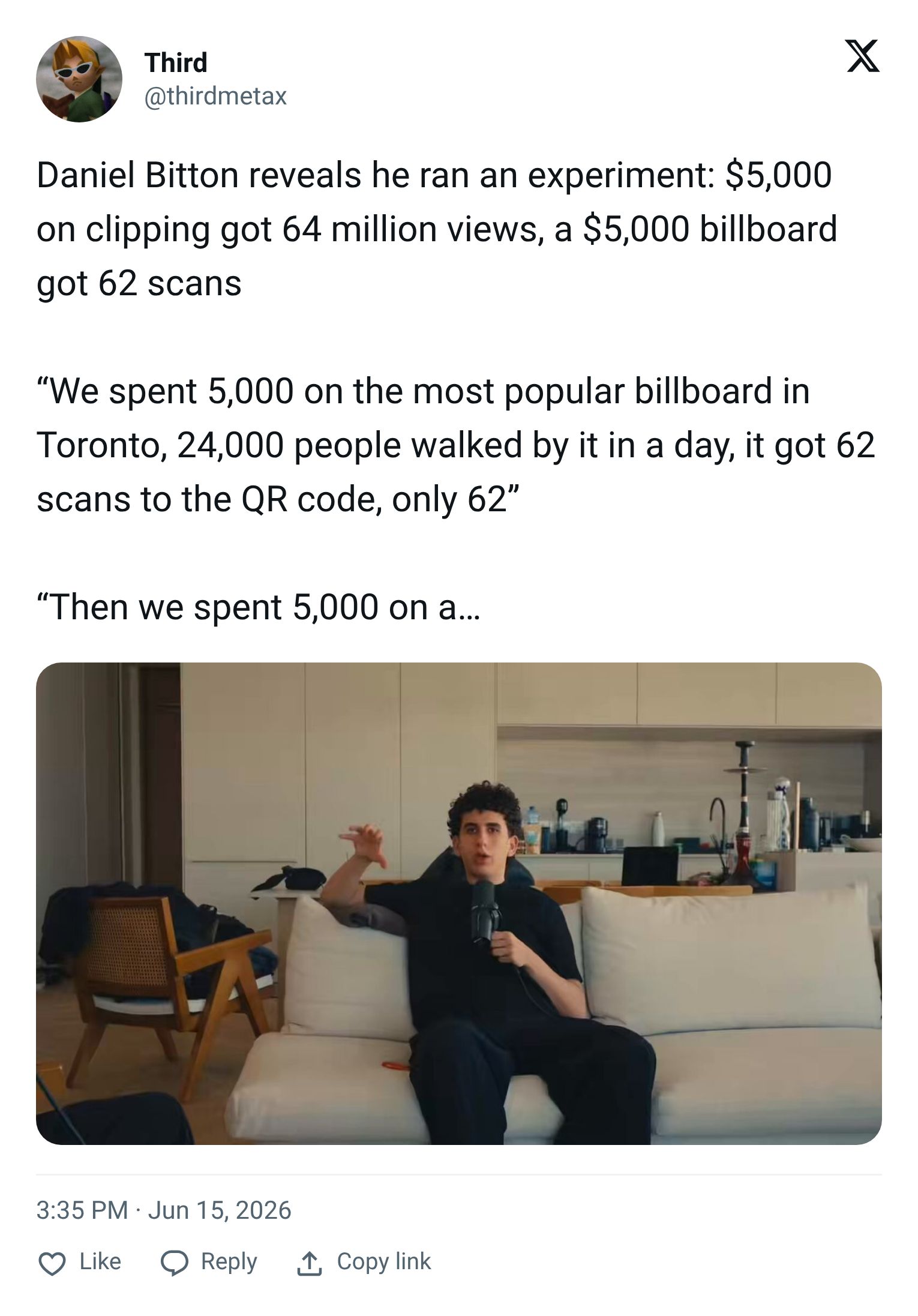
One founder put $5K into Toronto's busiest billboard: 24,000 walk-bys in a day → 62 QR scans.
But the boards people still talk about have 2 things in common.
Someone photographed them.
Someone shared them online.
So over the last 2 months, Smartlead, an outbound sales company used by 100,000+ businesses, bought billboards in 5 cities.
For example - a creator who spotted a poster in Miami posted about it, pulling 963 reactions and 415 comments.

Why would an online outbound company go offline?
Because Smartlead's own data on 6Bn+ emails shows cold email gets 1 reply per 135 contacts.
The inbox is crowded.
The feed is crowded.
Outbound needs an overhaul.
So here's the bet → reach is who walks past the board. But distribution is where the photo of it travels.
Shout out to the Smartlead team for making this breakdown happen.
Let’s get into it.

💡
Strategy Playbook: Buy the photo > Buying the footfall.

Breakdown
The how: The strategic playbook boiled down to 3x key takeaways
1. Make your customers the models
SoHo's billboards all sell the same thing: a logo + a lifestyle + a beautiful model.
In the middle of that row, Smartlead put up a fashion-shoot board with 1 line: "Not that kind of model."
“We wanted to ask whether there are other kinds of people who deserve to be put on a billboard too,”
Here's why this stuck → every face on that board comes with its own audience and its own reason to post.
So customer Nick Abraham took his parents to see his board in NYC.

His post about it (dropping out of college, then finally having something to show them) pulled in 436 reactions.
Smartlead made the customer the camera-facing surface, then let the customer do the filming.
Whether it's IG stories or entire billboards, people distribute what they star in.
2. 5 cities, 5 inside jokes
Most global campaigns run 1 master ad and translate it for different markets.
Smartlead said nope.
5 cities with 5 ideas, and none of them look alike.
Sure, it 5x’s your production costs to make highly custom copy.
But that's the point.
These boards are also harder to decode if you're not local.
And the local in-joke is exactly what locals stop to photograph.


New York (SoHo + Times Square): 2 boards. SoHo cast customers as the models. Times Square put Smartlead's founder on screen, grooving in sweats.

San Francisco (SoMa): most AI boards on the 101 lead with hype or funding. So Smartlead skipped the 101 for a quiet SoMa street, and put its biggest claim there: "25,000 emails sent while you read this."

Miami: no billboard at all. Instead, 500 guerrilla posters across Wynwood, Miami Beach, Downtown and the Design District.

London (Shoreditch): the heart of London's startup scene.

Sydney (Wynyard Station): "Mind the gap. We'll mind the pipeline." Wynyard is where founder Vaibhav Namburi caught the 1am last train in his early pitching days.
3. Hire the camera crew first
There is almost nothing about billboards that is measurable.
Even Stytch, which ran one of B2B's best-documented billboard campaigns, says you may never get 1 clean number for the board presentation.
Smartlead has the same problem. None of its boards carry a QR code or a tracked link, so there's no clean number for what they drove.
So Smartlead built the marketing crew before it bought the boards:
→ Customers with audiences, literally on the boards (see Nick).
→ A bench of 20-22 LinkedIn creators who were also Smartlead customers with 10-50K followers each, grown from 3-4 in under 12 months.
→ Events as photo ops: 6 events in 1 week during SF Tech Week.
And Smartlead's buyers (think founders, agencies and SaaS teams doing cold outreach at scale) basically live on LinkedIn - exactly where the photos travel.
Put these together and the results speak for themselves - this billboard campaign generated:
→ 2M+ organic impressions.
→ 6,000+ conversations among Smartlead's ICP.
→ Direct traffic increased by 30%.
→ Branded search traffic increased by 43%.
→ ~43% sign-up increase through the branded activities in Sept/Oct
Smartlead's next bet is called “Workforce”
A team of specialised AI workers coordinating the whole revenue journey, from finding prospects to creating pipeline.
Curious how best in class outbound actually runs in 2026?
Smartlead is built for SaaS companies doing cold outreach at scale, and 100,000+ businesses already run their outbound on it → see how it works.

Rabbit Hole
The where: 3x high-signal resources to learn more

[10 minute read]
Smartlead pulled the numbers from 850M+ emails sent through its platform in H1 2026.
→ Typical reply rate: 0.74% (1 reply per 135 contacts). The top 10%: 2.63%
→ First emails under 50 words win, at a 1.47% reply rate
→ 64% of replies land within an hour
The clearest picture of what the inbox actually looks like right now.

[12 minute read]
Stytch co-founder Reed McGinley-Stempel on the month Stytch put 80 bus ads, 130 shelters and 3 boards on the 101 across San Francisco.
When a billboard is worth it, how to run one, and what it actually did to branded search and pipeline.
The most honest B2B billboard post-mortem we’ve seen.

[3 minute read]
A short essay on why SF's AI billboards are photographed far more than they're seen.
Companies post the board, employees repost it, founders pose under it. The object becomes content about itself.
"San Francisco is, in many ways, physical LinkedIn."


Before you go, 2 things that might help your business:

One inbox for all your DMs: Slack, WhatsApp, iMessage, LinkedIn and X, with more coming soon. The Mac app that prioritises your chats, hides the noise, and drafts replies in your voice.

Put your business in front of the founders and tech leaders who read strategy for fun and buy tools for work. 150k+ email subscribers, 140k social followers, 2m impressions a month.
